Champagne AOC vs Cava, Prosecco, and Crémant: What's the Difference?
Champagne AOC vs Cava, Prosecco, and Crémant — method, grapes, geography, sweetness tiers, and why only one can legally be called Champagne. A respectful guide.
Walk into any Champagne cellar tour — like the Vollereaux visit in Pierry — and one of the first things the guide will explain is the AOC: Appellation d’Origine Contrôlée, the legal framework that says only sparkling wine from a specific French region, made in a specific way, can be sold as Champagne. The borders are exact, and the rules cover everything from approved grape varieties to minimum aging. Cava, Prosecco, and Crémant are simply different categories of sparkling wine, each with its own legal protections, production traditions, and legitimate place at the table. This guide explains the differences clearly, on their own terms.
The Four Categories in One Table
| Category | Region | Country | Primary grapes | Method | Typical sweetness | Typical price tier |
|---|---|---|---|---|---|---|
| Champagne AOC | Champagne | France | Chardonnay, Pinot Noir, Pinot Meunier | Méthode champenoise (traditional method, 2nd fermentation in bottle) | Mostly Brut | Premium |
| Crémant (multiple AOCs) | Alsace, Bourgogne, Loire, Limoux, Bordeaux, Jura, Savoie, Die | France | Varies by region (Chardonnay, Pinot, Chenin Blanc, Mauzac, etc.) | Traditional method, identical to Champagne | Mostly Brut | Mid-tier |
| Cava DO | Penedès (primarily), with strict zone delimitation | Spain | Macabeo, Xarel·lo, Parellada (traditional); Chardonnay, Pinot Noir also permitted | Traditional method (2nd fermentation in bottle) | Mostly Brut | Mid-tier |
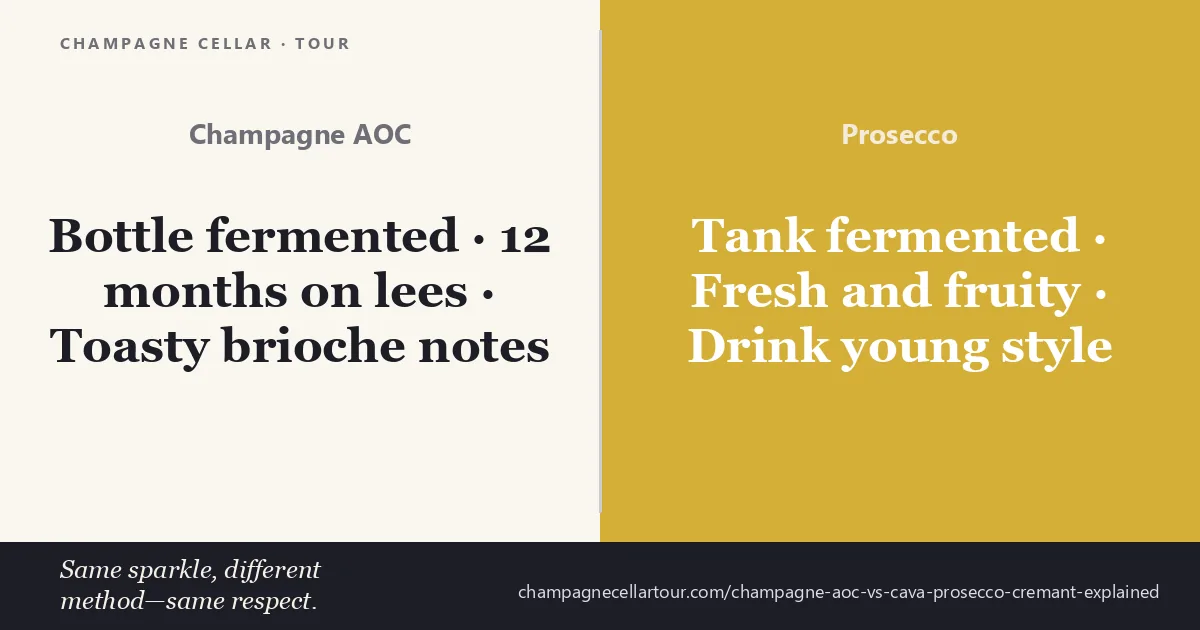
| Prosecco DOC / DOCG | Veneto + Friuli Venezia Giulia | Italy | Glera (predominantly) | Charmat / Martinotti method (2nd fermentation in tank) | Mostly Extra Dry (slightly sweeter than Brut) | Mid- to budget-tier |
Each of those rows is its own appellation with its own legal protection. The differences come down to three big things: where the grapes are grown, what grapes they are, and how the second fermentation is done.
What “Champagne AOC” Actually Means
The Champagne AOC was formally recognised in 1936 when France’s national appellation body (now the INAO) codified the rules, though geographic boundaries had been set earlier by a 1927 law defining exactly which villages could grow grapes for Champagne. The protection is serious cultural and economic infrastructure: it preserves a centuries-old wine tradition, underpins thousands of family livelihoods in the Marne Valley, and is defended vigorously through EU trade law. The scale matters too — the Comité Champagne (CIVC), representing around 16,000 vignerons and 350 Maisons, reported 2025 shipments of around 266 million bottles (roughly 114M France, 152M export), a third consecutive year of measured decline attributed to inflation, US distributor overstock, and geopolitical pressure on premium-wine demand.
The legal framework requires that Champagne:
- Comes from the Champagne region of northeastern France — the CIVC officially divides the region into four main growing zones (Montagne de Reims, Vallée de la Marne, Côte des Blancs, Côte des Bar), with the Côte de Sézanne grouped as a southern extension of the Côte des Blancs
- Is made from approved grape varieties — primarily Chardonnay, Pinot Noir, and Pinot Meunier (plus a few permitted under historical exceptions)
- Undergoes secondary fermentation in the bottle — the méthode champenoise
- Meets minimum aging — at least 12 months on the lees for non-vintage, minimum 15 months total bottling-to-release (longer for vintage)
- Meets manual harvest, pressing yield, and other production standards
These growing zones sit on the chalk subsoil that also keeps cellars at a constant 10–12 °C year-round. The Reims and Épernay cellars are part of the Champagne Hillsides, Houses and Cellars UNESCO World Heritage site inscribed in 2015.
Méthode Champenoise: What “Traditional Method” Means
The technical heart of the Champagne AOC, and what Cava and Crémant share with it, is the méthode champenoise — also called the traditional method. In broad strokes:
- Base wine — primary fermentation in tanks or barrels, the way still wine is made
- Tirage — base wine is blended (assemblage), bottled, with yeast + sugar added to trigger a second fermentation in the sealed bottle
- Second fermentation in bottle — yeast eats the sugar and the CO₂ has nowhere to go: the bubbles
- Aging on the lees — bottles rest horizontally on dead yeast cells; develops the toasty, brioche notes
- Riddling (remuage) — bottles are rotated and tilted neck-down so sediment collects at the cap
- Dégorgement — neck is frozen, cap removed, yeast plug pops out
- Dosage — sugar-and-wine top-up sets the final sweetness level
- Final corking and bottle finishing
For non-vintage Champagne, the AOC requires at least 12 months on the lees and 15 months total bottling-to-release; many houses age longer, and vintage cuvées can rest a decade or more. Cava and Crémant follow the same eight-step process — the shared method is why all three taste structurally similar, with the yeasty, biscuity character that comes from extended lees contact.
Prosecco does it differently. Its second fermentation happens in large stainless-steel tanks rather than individual bottles — the Charmat / Martinotti method, after its 19th-century Italian originator. Tank fermentation is faster, more uniform, and significantly cheaper, and produces a different flavour: fresher, fruitier, less toasty — a deliberately different style, not a worse one.
The Dosage / Sweetness Spectrum
All four categories use the same EU dosage labelling — grams of residual sugar per litre, mapped to a named tier:
| Label | Residual sugar | Where you’ll see it |
|---|---|---|
| Brut Nature (Pas Dosé, Zéro Dosage) | Less than 3 g/L | Premium Champagne and Crémant; some Cava |
| Extra Brut | 0–6 g/L | Premium Champagne and Crémant |
| Brut | Less than 12 g/L | The default; most Champagne, Cava, and Crémant you’ll drink |
| Extra Sec / Extra Dry | 12–17 g/L | Most Prosecco (yes — “Extra Dry” is sweeter than Brut, a perennial source of confusion) |
| Sec / Dry | 17–32 g/L | Dessert-friendly |
| Demi-Sec | 32–50 g/L | Sweet, dessert pairing |
| Doux | More than 50 g/L | Rare; old-style sweet |
“Brut” on a Champagne label means the same thing on a Cava or Crémant label — under 12 g/L. The dry style itself is historically recent: Madame Louise Pommery launched the first commercially successful dry Champagne with Pommery Nature 1874, breaking a tradition of heavily sweetened wines and effectively creating the modern Brut category for the British market. Prosecco at “Extra Dry” is sweeter than any of them because the dominant Prosecco style sits in the 12–17 g/L range. None of this is a quality difference; it is a stylistic difference.
So What About Cava, Crémant, and Prosecco?
Cava is Spain’s traditional-method sparkling wine, primarily from Catalonia’s Penedès region under a delimited DO. The native grape blend — Macabeo, Xarel·lo, and Parellada — gives Cava a different aromatic profile (often more citrus, less brioche), though Chardonnay and Pinot Noir are also permitted. The Reserva and Gran Reserva designations, plus the elite Cava de Paraje Calificado single-vineyard tier, are worth seeking out for serious quality. Paraje Calificado is the DO’s most stringent tier — minimum 36 months on lees, maximum 8,000 kg/ha yield, hand harvest, vintage-dated only, and 100% organic from the 2025 harvest forward; just 15 wines hold the distinction as of March 2026. Like Champagne, Cava is made the slow expensive way; the price difference is geography, not craft.
Crémant is the umbrella label for traditional-method sparkling wines from eight French regions outside Champagne — Alsace, Bourgogne, Loire, Limoux, Bordeaux, Jura, Savoie, and Die. Each Crémant AOC has its own grape rules tailored to its region (Chenin Blanc in Loire, Mauzac in Limoux, Pinot Blanc in Alsace). The Limoux producers in particular have a credible case that their version of the traditional method predates Champagne’s by about a century. A good Crémant is structurally comparable to Champagne at a fraction of the price; many French sommeliers serve it by the glass for exactly that reason.
English sparkling wine is the newest serious entrant in the traditional-method conversation. Sussex sparkling wine earned PDO status on 5 July 2022 — the UK’s first post-Brexit wine PDO — mandating traditional method, the classic Chardonnay/Pinot Noir/Pinot Meunier trio, hand harvesting, and a minimum of 15 months on the lees. Sussex and Kent producers work chalk-and-greensand soils that share a geological lineage with the Champagne region across the Channel; it is its own emerging category, with its own legal protection.
Prosecco is the global success story of Italian sparkling wine. Made from the Glera grape in Veneto and Friuli, it is intentionally lighter and fresher than Champagne — drink-young, food-friendly, lower in alcohol, lower in price. The grape was formally renamed from “Prosecco” to “Glera” by EU Regulation 1166/2009, effective 1 January 2010, so that “Prosecco” could be reserved exclusively as a protected geographic indication — the same legal logic that protects “Champagne.” The DOCG tiers (Conegliano-Valdobbiadene and Asolo) come from steeper hillside sites and represent the category’s quality apex; the broader Prosecco DOC covers a much larger area. Prosecco is not trying to be Champagne — it is a different drink with a different point.
Why It Matters on a Cellar Tour
Knowing the framework changes what you taste. On a guided cellar visit, you can ask the right questions: which grape dominates this cuvée, how long did it age on lees, what dosage tier? At Vollereaux you taste 3 estate cuvées — a Brut, a Blanc de Blancs (100% Chardonnay) or Rosé, and a vintage or special cuvée — and knowing the vocabulary lets you actually compare them. The Vollereaux cellar tour is built around that kind of side-by-side learning at $20 for three guided tastings.
Common Mistakes Worth Avoiding
- “Champagne” used as a generic term for any sparkling wine. Wrong, and in the EU and most trading-partner countries it is also illegal commercial use. The word denotes the protected origin.
- Treating Prosecco as a budget substitute for Champagne. It isn’t trying to be Champagne. Comparing them is like comparing pilsner to Belgian abbey ale — same broad category, completely different goals.
- Assuming “Extra Dry” Prosecco is drier than “Brut” Champagne. The opposite — see the dosage table.
- Assuming Cava is a downgrade from Champagne because it costs less. The labour, time, and traditional method are the same; the price difference comes from geography and the cost structure of the Champagne region.
Ready to Book?
The best way to understand Champagne AOC is to stand inside one of its working chalk cellars while a guide walks you through the entire framework — the geography, the grapes, the method, the dosage tiers, all in front of the bottles ageing under the same chalk that gives Champagne its character. The Vollereaux cellar tour in Pierry does exactly this for $20: 1 hour, 3 estate cuvées tasted, English- or French-speaking guide, free cancellation up to 24 hours before. See also our Reims vs Épernay guide to pick where to base your visit.
Taste the Marne Valley — 1 Cellar, 3 Cuvées
Join 532+ guests who rated this 4.7/5. One guided cellar visit, three estate Champagnes poured by your guide, and free cancellation up to 24 hours ahead — same price as buying direct from the Maison.
Check Availability & Book