Champagne Cellar Tour Dress Code & What to Bring
Champagne cellar tour dress code — light jacket (10-12°C chalk cellars), closed-toe shoes, no perfume. Full packing list for a Marne Valley visit.
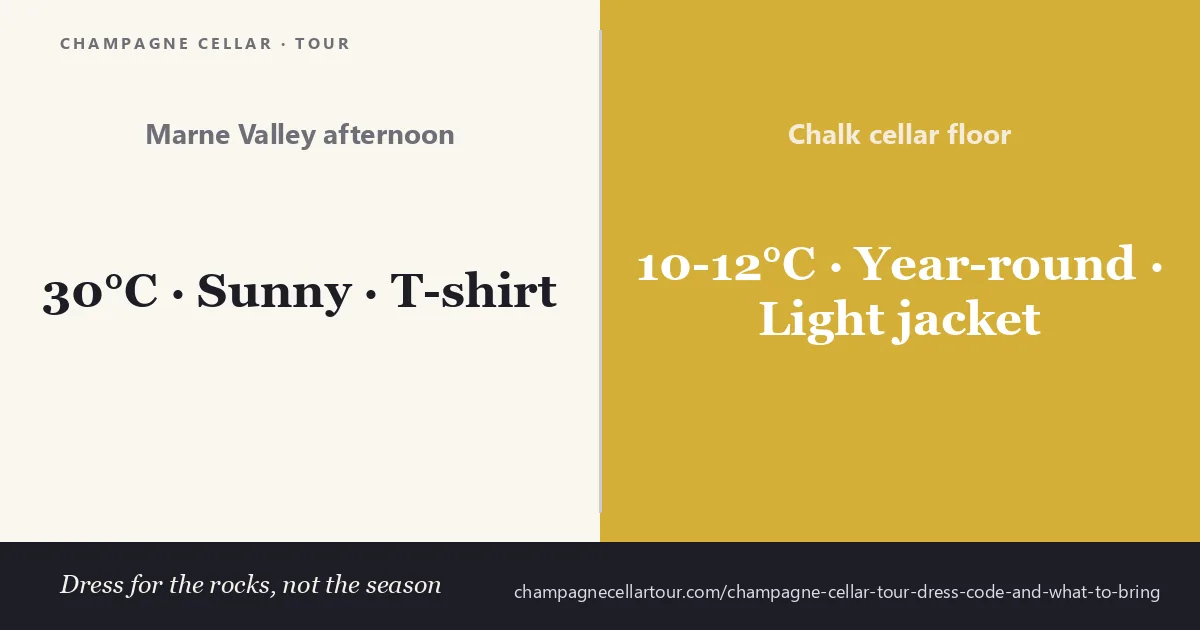
Champagne cellars are dug deep into chalk, and that single fact drives the entire dress code: they sit at a constant 10–12 °C (50–54 °F) year-round, regardless of whether it is 30 °C and sunny in Épernay above ground or snowing in Reims in February. Bring a light jacket, wear shoes with grip, and skip the heavy cologne, and you will be comfortable everywhere from the Vollereaux cellar tour in Pierry to the grandes marques of Reims. This guide unpacks why the rules exist and what to actually put in your day bag.
The One-Sentence Version
A light sweater or jacket, closed-toe shoes with grip, smart-casual clothing for the tasting room, and no heavy perfume — that combination works for every cellar visit in the Marne Valley in every season.
Why Cellars Are Always Cold
The Champagne region sits on a thick layer of Cretaceous chalk — the same chalk that gives Champagne wines their characteristic minerality and that you can see in the white cliffs visible across the English Channel. When you dig a cellar into chalk, the surrounding rock acts as a giant thermal buffer. The temperature deep underground in the Marne Valley settles at the long-term average ground temperature for that latitude, which is approximately 10–12 °C. It barely shifts across the seasons.
For Champagne producers, this is the whole reason cellars exist where they do. Wine ages best slowly and at cool, stable temperatures. A natural chalk cellar provides exactly that, year after year, with no refrigeration cost. The scale of the underground system is part of why Reims and Épernay were inscribed on the UNESCO World Heritage list in 2015: Saint-Nicaise Hill in Reims alone holds around 57 km of Gallo-Roman crayères (chalk quarries repurposed as cellars), some chambers over 30 m high and up to 40 m below the surface, while around 110 km of cellars run beneath Épernay’s Avenue de Champagne holding roughly 200 million bottles in slow maturation. You are walking inside that system every time you descend.
For you as a visitor, it means the cellar is going to feel cold the moment you descend the stairs — pleasantly cool on a hot August day, genuinely cold in any other season. Most cellar tours spend 30–45 minutes underground; without a jacket, that’s enough time to feel uncomfortable.
What to Wear, Layer by Layer
| Layer | What works | What to avoid |
|---|---|---|
| Top | A light sweater, cardigan, or jacket you can put on at the cellar door and take off in the tasting room | Heavy winter coat in summer (you’ll cook on the walk back); thin t-shirt only in cooler seasons |
| Bottom | Long trousers (jeans, chinos) any season; comfortable skirt/dress works in summer with bare legs | Shorts and bare legs in shoulder-season or winter — chalk cellars feel especially cold below the knee |
| Shoes | Closed-toe with grip — sneakers, loafers, low boots, leather flats | Open-toe sandals, flip-flops, high heels, brand-new soles with no traction |
| Outer | Light raincoat or compact umbrella in shoulder season | Bulky travel umbrella you’ll have to leave at the door |
The “closed-toe with grip” rule matters more than visitors expect. Cellar floors are stone or compacted chalk, sometimes slightly damp from the constant humidity, occasionally uneven where centuries of foot traffic have worn grooves. They are not dangerous, but they are not a polished hotel lobby either. Sneakers, low boots, or rubber-soled flats handle them easily; smooth-soled dress shoes and high heels are awkward and slightly risky.
What to Bring in a Small Bag
Pack light — most cellar tours don’t have storage and you’ll be walking with whatever you carry.
- A light jacket or sweater — even in July
- Water bottle — Champagne tastings are dehydrating; sip water between cuvées
- Phone fully charged — for photos and for any return-taxi booking
- Card and a small amount of cash — most estate boutiques take card; cash is a backup
- Small backpack or crossbody bag — both hands free
- Passport or ID — required at booking confirmation for some Maisons
- Booking confirmation — printed or on your phone (QR/email)
- Tissues — chalk dust is mild but real
- Compact umbrella — for shoulder-season Marne Valley weather
What NOT to bring:
- Heavy perfume or cologne — strongly discouraged at every Champagne Maison; perfume interferes with everyone’s tasting, not just yours. If you applied it that morning, you can’t fully reverse it, but skip the touch-up at lunch
- Wheeled suitcase — if you’re coming straight off a TGV from Paris, leave the bag at Gare de l’Est left luggage
- Strollers or large prams — cellars have stone steps and tight passages; most Maisons cannot accommodate
- Pets — explicitly not allowed at most Maisons including Vollereaux
Tasting-Room Dress Code
The tasting room is brighter, warmer, and dressier in feel than the cellar itself. Smart-casual is the norm across every Champagne house — neat shirt and trousers or jeans, neat dress or skirt, polished sneakers all fit. Nobody expects a jacket-and-tie or a cocktail dress; nobody minds either if you arrive that way.
For a special occasion — a milestone birthday, a proposal, an anniversary trip — dressing up slightly is appreciated by the staff and makes the photos better. For a normal day-trip cellar visit, neat travel clothes are fine.
A few Maisons in Reims and along the Avenue de Champagne in Épernay run lunch or dinner tastings in dedicated dining rooms. For those, lean dressier — jeans and a button-down work, athletic wear and gym shoes don’t. The Reims vs Épernay guide outlines which kind of Maison fits which kind of visit.
The Perfume Rule Explained
Of all the cellar-tour etiquette rules, “no perfume” is the one that catches visitors most off guard. The reason is straightforward: Champagne tasting is built around smelling the wine. The aroma — toast, brioche, citrus, white flowers, dried apricot — is half of what you’re evaluating. Strong perfume or cologne sits on your skin for hours, hangs in the air around you, and overrides everything subtle in the wine. Other guests at the tasting table will smell your perfume more than the Champagne in their glass.
Sommeliers, wine writers, and producer tasting-room staff all follow the same convention themselves: no fragrance on tasting days. The rule isn’t snobbery — it’s practical, and applying it shows respect for the work of the people pouring for you.
If you wore perfume that morning and only later realised, don’t panic — a brief shower of cold water on the wrists helps; some Maisons keep neutral hand-wash by the cellar entrance. Just avoid reapplying through the day.
By Season
Spring (March–May). Above ground often mild but unsettled; below ground 10–12 °C as always. Bring a sweater plus a light raincoat. Closed-toe shoes essential — wet cellar entrances are common after spring rain.
Summer (June–August). Above ground can hit 30 °C and humid in the Marne Valley; the cellar will still feel cold. Counterintuitively, summer is when visitors most forget the jacket and most regret it. A linen overshirt or light cardigan you can tie around your waist works perfectly. Bare legs in skirts/shorts are fine but expect to feel the cellar chill below the knee.
Autumn (September–November). September is harvest season and often the most pleasant month to visit — warm days, cooler evenings, the vineyards photogenic. Layer a sweater under a light jacket. October and November turn cooler; bring a proper jacket for the walk between station and Maison.
Winter (December–February). Above ground can be 0–5 °C with damp cold; below ground identical to every other month. The cellar will feel slightly less of a temperature drop because you’re already cold. Wear a proper warm coat for the outdoor portions; you can hang it in the tasting room.
At the Tasting Itself — Quick Etiquette
You don’t need to know wine to enjoy a cellar tour, but a few small conventions make the experience smoother for everyone:
- Hold the glass by the stem, not the bowl, to keep the wine from warming
- Swirl gently before smelling — this releases aroma
- Smell before sipping — the aroma is half the wine
- Spit if you want to; many guests do not, but spittoons are usually offered and using one is normal at multi-tasting visits
- Ask questions — the guide is there for exactly this, and good questions get better answers
- Don’t ask the price during the tasting — wait until the tasting ends; the guide will steer you to the boutique
- Tip is not expected at French Maison tastings (under French service compris convention, the visit fee includes service — unlike US wine country, where tipping is standard); a sincere thank-you and, if you enjoyed the wine, buying a bottle from the estate boutique is the appreciated gesture
After the tasting, the Champagne AOC explainer is a good post-visit read — it puts what you just tasted in context with the broader sparkling-wine world.
Special Cases
Pregnant guests. Welcome on the cellar walk; let the guide know in advance so they can offer water or sparkling water as a tasting alternative.
Designated drivers / non-drinkers. Welcome and common; non-drinkers either skip the tastings or take small sips. Some tours allow you to opt out of tastings at booking.
Under-18s. Where legally permitted to join (most cellar tours allow accompanied minors on the walk but not the tasting), bring water and snacks for the kids. Vollereaux and other family-run Maisons are generally welcoming.
Mobility limitations. Cellars have steep stone steps and uneven floors; very few are wheelchair-accessible. Call ahead to ask about the specific Maison’s accessibility — some grandes marques in Reims have invested in lifts and step-free routes; smaller village Maisons typically have not.
Allergies or dietary restrictions. The cellar visit itself is no issue; for tours that include a lunch or food pairing, note dietary needs at booking.
Ready to Book?
The Vollereaux cellar tour in Pierry is a 1-hour guided cellar walk plus a tasting of 3 estate Champagnes — $20 per person, free cancellation up to 24 hours before. Dress for 10–12 °C and the tasting will look after itself.
Taste the Marne Valley — 1 Cellar, 3 Cuvées
Join 532+ guests who rated this 4.7/5. One guided cellar visit, three estate Champagnes poured by your guide, and free cancellation up to 24 hours ahead — same price as buying direct from the Maison.
Check Availability & Book