Reims vs Épernay: Which Champagne Region Should You Visit?
Reims vs Épernay for your Champagne cellar tour — TGV times, grandes marques vs family Maisons, cathedral vs Avenue de Champagne. A balanced day-visitor's guide.
Picking between Reims and Épernay is the first real decision for a Champagne-region day trip, and there is no single right answer — only the right answer for the way you want to spend the day. Reims is the bigger city, the easier rail connection from Paris, and the historical capital of the grandes marques. Épernay is smaller, denser, and built around a single street where the famous houses sit shoulder to shoulder. Either one anchors a great visit; the featured Vollereaux cellar tour sits just south of Épernay, but plenty of travellers split the day between both towns. This guide walks through how each one feels on the ground so you can pick the one that fits your trip.
The Quick Answer
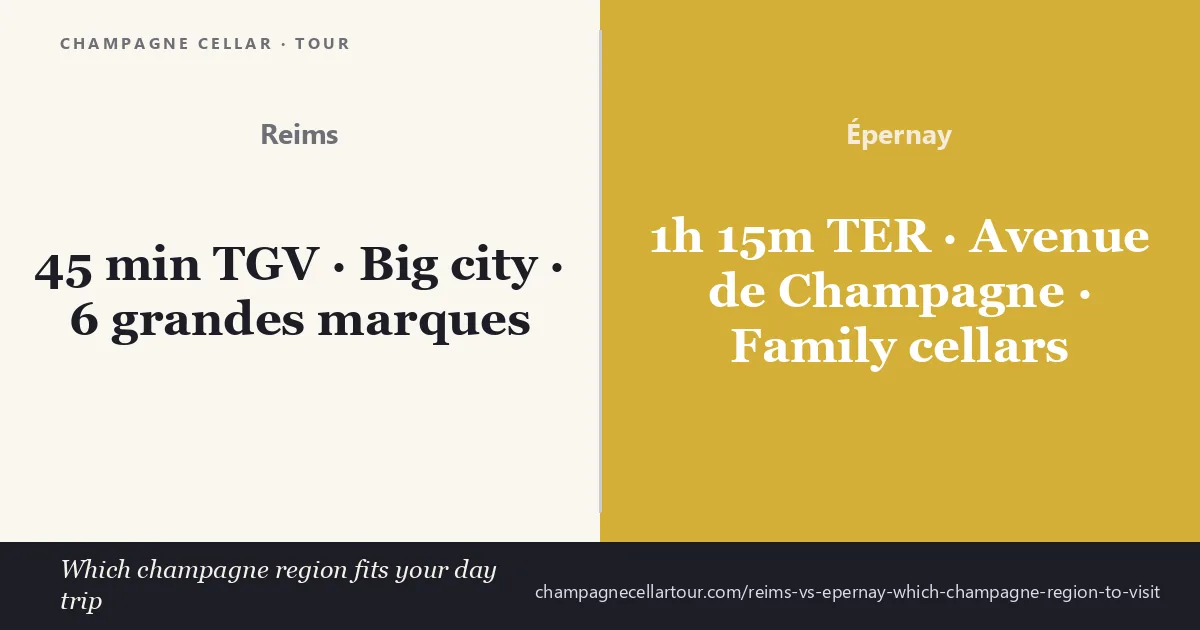
If you only read one paragraph: choose Reims if you want the easier train from Paris, cathedral sightseeing alongside cellar visits, and the marquee names (Veuve Clicquot, Taittinger, Pommery, Ruinart) on your itinerary. Choose Épernay if you want a more concentrated cellar district — the Avenue de Champagne — plus easy access to family-run village Maisons in the surrounding Marne Valley like Vollereaux in Pierry. Many people do both: train into Reims in the morning, spend the afternoon in Épernay, train back to Paris from either.
Side-by-Side: Reims vs Épernay
| Factor | Reims | Épernay |
|---|---|---|
| Population | Around 180,000 — a real city | Around 22,000 — small town |
| Train from Paris Gare de l’Est | About 45 minutes (TGV high-speed) | About 1 hour 15 minutes to 1 hour 30 minutes (direct TER regional, no TGV station) |
| Signature attraction | Notre-Dame de Reims (UNESCO, coronation cathedral of French kings) | Avenue de Champagne (UNESCO Champagne Hillsides, Houses and Cellars 2015) |
| Headline Maisons | Veuve Clicquot, Taittinger, Pommery, G.H. Mumm, Ruinart, Lanson | Moët & Chandon, Perrier-Jouët, Pol Roger, De Castellane, Mercier |
| Cellar concentration | Spread across the city + outskirts | Concentrated along ≈1 km of one boulevard |
| Day-trip surrounding villages | Hautvillers (Dom Pérignon’s village), Verzenay, Verzy | Pierry, Aÿ, Cumières, Mareuil-sur-Aÿ |
| Best for | First-timers, history buffs, anyone wanting cathedral + cellar in one day | Champagne-focused visitors, family-Maison seekers, those wanting easy walking between cellars |
Reims: The Royal City of Champagne
Reims feels like a French regional capital because that is what it is. The cathedral — where every French king from the medieval period to Charles X was crowned — stands at the centre, and the cellar Maisons radiate out from it. Entry to the cathedral nave itself is free (open roughly 7:30am to 7:30pm daily, slightly earlier close on Sundays); the separately-ticketed tower climb, operated by the Centre des monuments nationaux, is the optional add-on. The grandes marques here are large operations with full visitor centres and choreographed tasting experiences. They lean polished and corporate, in the best sense: clean floors, multilingual guides, well-built tastings, and gift shops that run like high-end retail.
Reims grandes marques typically require advance booking, sometimes a week or more in peak season. Several of the most prestigious — Ruinart and Krug among them — are appointment-only with strict group-size limits and price points that reflect their cult status. Veuve Clicquot, Taittinger, Pommery, G.H. Mumm, and Lanson all run regular public visits and are easier to slot into a day trip if you book ahead. Indicative 2026 pricing: Taittinger entry-level tours from around €40, Veuve Clicquot’s short Brut Yellow Label visit from around €36 (its flagship 4-hour Cellars Tour climbs to around €260), and Moët & Chandon in Épernay from around €48 up to €460 for prestige experiences. If you plan to combine cellar visits with city sightseeing, the Pass Reims-Épernay (around €22 for 24 hours, €32 for 48 hours, €42 for 72 hours in 2026) bundles museums, public transport, the Verzenay lighthouse, and the cathedral towers with discounts at participating Maisons.
The Reims advantage is logistical. From Paris Gare de l’Est the TGV gets you in around 45 minutes, which means you can leave Paris at 9am and be tasting Champagne before noon. You can spend the morning in a Maison, lunch in the city, see the cathedral and the Palais du Tau in the afternoon, then catch a TGV back in the early evening. For a one-day Champagne trip from Paris by rail, Reims simply works better than Épernay — Épernay does not have a TGV station of its own, so direct service from Paris is a regional TER train of about 1h15–1h30.
Épernay: The Avenue and the Villages
Épernay is the opposite proposition. It is small enough to walk end-to-end, and most of the city’s prestige is squeezed into a single street: the Avenue de Champagne, lined with the grand façades of Moët & Chandon, Perrier-Jouët, Pol Roger, De Castellane, and Mercier. The underground cellars beneath the Avenue together hold many millions of bottles aging in chalk — the kind of statistic that becomes vivid only when you descend into one.
The Avenue de Champagne is also more democratic than the Reims spread: you can comfortably walk between several Maisons in an afternoon without a car or train ticket between them. Moët & Chandon is the obvious anchor for first-timers — biggest, most polished, runs frequent guided visits — but the smaller Maisons often offer better value and a more intimate tasting if you book ahead.
The real Épernay magic, though, is the surrounding villages. Within a 15-minute drive (or a short taxi from Épernay TGV) you reach Pierry, Aÿ, Cumières, Mareuil-sur-Aÿ — small wine-growing villages where family-run Maisons like Champagne Vollereaux in Pierry operate working cellars that have been in the same family for generations. Vollereaux has been producing since 1805 and the 6th generation of the family still runs the estate; you walk into 200-year-old chalk cellars, taste 3 distinct cuvées poured by the producer’s team, and pay around $20 for the visit. Nothing in Reims will get you the same atmosphere at the same price.
Train and Logistics
The rail option from Paris is the single most important practical factor.
- Paris Gare de l’Est → Reims Centre: about 45 minutes; TGV high-speed; multiple direct services daily
- Paris Gare de l’Est → Épernay: about 1 hour 15 minutes to 1 hour 30 minutes; direct TER InterCités (regional, not TGV); Épernay does not have a TGV station
One catch worth knowing: Reims has two stations. Most TGVs stop at Reims Centre, which is in the city and walking distance from the cathedral. A handful stop only at Champagne-Ardenne TGV, an outlying station in the commune of Bezannes about 8 km from Reims Centre that requires the Citura tram Line B (around 20–30 minutes) or a quick TER shuttle (around 10–12 minutes) into the city. When you book, check the destination station carefully.
For Épernay there is just one station — Gare d’Épernay, served by direct TER InterCités trains from Paris Gare de l’Est (not TGV). It sits a short walk from the bottom of the Avenue de Champagne — extremely convenient. For onward travel to village Maisons like Vollereaux in Pierry, you take a short taxi from the station or, in good weather, walk the roughly 3 km.
When You Don’t Have to Choose
Plenty of full-day tours from Paris hit both Reims and Épernay in a single trip — typically a morning Maison visit in Reims, lunch somewhere along the route, then an afternoon stop in Épernay or one of the surrounding villages. These are 10-11 hour days with door-to-door transport from central Paris, no train tickets to coordinate, and prices around $379+ per person for full-day options with multiple tastings and lunch. If your trip allows only one day for Champagne, this is the maximum-coverage option — see how it stacks up in the Vollereaux cellar tour vs Paris day-trip comparison on the home page.
If you have two days, the cleanest split is Reims day one (cathedral + grande marque), Épernay day two (Avenue de Champagne + a village Maison). Sleep in either town — Reims has more restaurants and a wider hotel range; Épernay is quieter and more focused on the Champagne trade.
Picking by Visitor Profile
First time in the Champagne region, one day to spare: Reims. The train is faster, the city is bigger if you want to mix in non-wine sightseeing, and the grandes marques are well set up for first-timers.
Wine-focused, want to taste at family producers: Épernay plus a village Maison. Book a session at Vollereaux in Pierry or another small estate alongside an Avenue de Champagne visit.
Want the architecture experience: Toss-up — Reims has the cathedral plus the Saint-Nicaise Hill crayères (around 57 km of Gallo-Roman chalk-quarry galleries up to 40 m deep, some chambers over 30 m high, used as cellars by Pommery, Taittinger, Ruinart, and others); the Avenue de Champagne has its parade of grand 19th-century mansions with roughly 110 km of underground cellars beneath the boulevard holding an estimated 200 million bottles. Both are part of the same 2015 UNESCO inscription “Champagne Hillsides, Houses and Cellars,” which covers three component zones: the historic vineyards of Hautvillers, Aÿ, and Mareuil-sur-Aÿ; Saint-Nicaise Hill in Reims; and the Avenue de Champagne plus Fort Chabrol in Épernay.
Travelling with kids or non-drinkers: Reims. Cathedral + Palais du Tau + city restaurants give non-tasting members of the group plenty to do while one adult does a cellar visit.
Budget-conscious: Épernay villages. A $20 cellar tour at Vollereaux beats anything Reims offers at that price point. The things to know about Champagne AOC before you go will sharpen what you taste.
Premium / appointment-only Maisons (Krug, Salon, etc.): Reims. The most prestigious houses cluster there.
Practical Wrap-Up
Cellars in both regions sit at constant 10–12 °C year-round because they are dug into Champagne’s chalk subsoil — bring a light jacket regardless of the weather above ground, in any season. See our dress code and what to bring guide for the full packing list. For the Paris commute, our TGV-to-Champagne day-trip planner walks through train timings, ticket booking, and how to get from each station to your tasting.
Ready to Book?
The Vollereaux cellar tour is the best-value cellar experience in the Marne Valley — 1 hour, 3 estate cuvées, $20, free cancellation. If you’re committing to Épernay as your base for the day, it’s a natural anchor; if you’re using Reims, you can still build it into the back half of an Épernay afternoon.
Taste the Marne Valley — 1 Cellar, 3 Cuvées
Join 532+ guests who rated this 4.7/5. One guided cellar visit, three estate Champagnes poured by your guide, and free cancellation up to 24 hours ahead — same price as buying direct from the Maison.
Check Availability & Book